You show up. You train hard, swing hard, and run hard. Then a nagging shoulder, a cranky knee, or a tight lower back starts dictating what you can and cannot do.
If you live in Laguna Niguel and love being active, you know how frustrating that feels. Maybe you chase PRs at the CrossFit box, work on your handicap at the course, or log miles along the coast. Being told to “just rest” can feel like being benched from your own life.
There is a better path. At The Movement Schopp, we treat injuries and build performance at the same time, so you do not just get out of pain. You come back moving better than before.
Why “Rest and Avoid Activity” Keeps Letting Active People Down
Rest has a place, especially right after an acute injury. But rest alone rarely fixes the reason the problem started. When you return to your sport, the same weak link is still there, and the pain often comes right back.
Most recurring aches in active adults trace back to a few common patterns:
- Limited mobility in one joint, forcing another joint to work overtime
- Strength gaps between muscle groups, especially in the hips, core, and shoulder blades
- Technique habits in the swing, stride, or lift that overload the same tissue again and again
- Training load that climbed faster than your body could adapt
Generic care tends to focus on the sore spot. Performance-focused physical therapy looks at the whole system, because your knee pain may start at your hip, and your shoulder pain may start in your upper back.
What Makes Performance Physical Therapy Different?
Performance physical therapy treats you like an athlete, not just a patient. At The Movement Schopp, our therapists bring a movement-first, sports-first philosophy to every session. Our team members are active athletes themselves, so they understand the mental weight of being sidelined just as well as the physical side.
Here is what that looks like in practice:
- One-on-one care. You work directly with your therapist, not a rotating crowd of assistants.
- Root cause thinking. We ask why the problem started, not just where it hurts.
- Rehab plus performance. Your plan targets pain relief and also swing efficiency, running mechanics, and lifting technique.
- Advanced training. Our team’s certifications include TPI Level 2, Blood Flow Restriction (BFR) training, Myofascial Decompression, IASTM, and Board Certified Orthopedic Clinical Specialist (OCS).
The goal is straightforward: get you back in your sport quickly and equipped to stay there.
How Physical Therapy Helps Golfers in Laguna Niguel
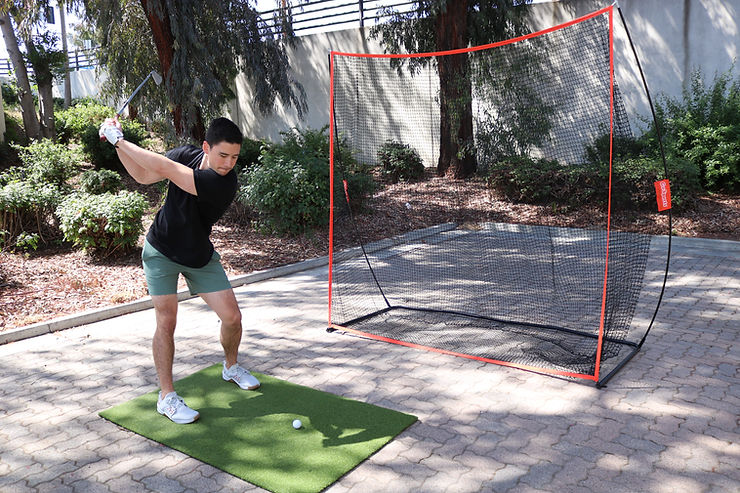
Golf looks smooth, but the swing asks a great deal from your body. It requires rotation through your hips and upper back, stability through your core, and fast, repeatable loading of your shoulders, elbows, and wrists. When one area lacks mobility or control, another area pays for it.
Common Golf-Related Injuries We Treat
Golfers often come to us with problems such as:
- Low back pain, one of the most commonly reported complaints among golfers
- Shoulder pain, including impingement and rotator cuff irritation
- Golfer’s elbow
- Hip pain and hip impingement (FAI) that limit rotation
- Wrist and hand pain
These issues rarely come from a single bad swing. They usually build from physical limitations that quietly change how you move over dozens of rounds and range sessions.
How TPI Testing Connects Your Body to Your Swing
The Titleist Performance Institute (TPI) is a golf education organization built around the relationship between how your body moves and how you swing. Our therapists are TPI certified at Level 2, which means we can run TPI testing and a movement screen to identify which physical limitations may be affecting your swing and contributing to pain.
For example, limited hip rotation may push extra stress into your lower back. Weak shoulder blade control may make overhead and follow-through positions feel pinchy. Once we find the cause, your plan may combine manual therapy, mobility work, resistance training, and neuromuscular re-education so your body can support the swing you want.
How Physical Therapy Helps Runners Get Back on Pace
Running is repetitive by nature. Every mile adds up to thousands of foot strikes, and small inefficiencies can turn into overuse injuries when training volume rises. Whether you are preparing for a 5K, a half marathon, or a triathlon, pain that interrupts your plan deserves a closer look.
Running Injuries We See Most Often
Runners and endurance athletes in Orange County frequently seek help for:
- Runner’s knee (patellofemoral pain)
- IT band syndrome
- Achilles tendinopathy
- Plantar fasciitis
- Shin splints
- Hamstring strain
- Hip pain and groin pain
- Ankle sprains
What Running Gait Analysis Reveals
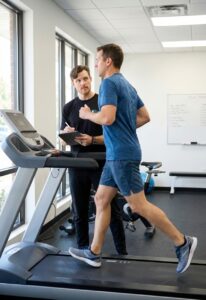
A running gait analysis and running form assessment give us a clear picture of how you move at speed. We examine posture, stride pattern, cadence, foot strike, and how your hips and trunk control each step. Pairing that data with a functional movement assessment helps us connect what we observe on the run to the strength and mobility limitations we find during hands-on examination.
From there, your plan may include therapeutic exercise, balance and proprioception training, plyometrics, and a structured return-to-running progression. You will know what to do, why you are doing it, and how it ties back to your goals.

How Physical Therapy Helps CrossFit and Functional Fitness Athletes
CrossFit blends heavy lifting, gymnastics, and high-intensity conditioning. That variety builds a capable athlete, but it also stacks demands on your shoulders, spine, hips, and knees. Fatigue, limited mobility, or small technique breakdowns can surface quickly when you are moving under load.
Pain That Shows Up Most Often in CrossFit
Common problem areas include:
- Shoulder pain and rotator cuff irritation from overhead lifts, kipping, and gymnastics movements
- Low back pain during deadlifts, squats, and cleans
- Knee pain from squatting, jumping, and high-repetition work
- Elbow and wrist pain from grip-heavy movements
- Hip impingement that limits squat depth
- Achilles and calf irritation from jumping and jump rope work
How We Keep You Training While You Recover
We rarely tell a CrossFit athlete to stop training entirely. Instead, we help you modify intelligently, so you keep building fitness while the irritated tissue calms down. Your therapist will assess your squat, hinge, press, and pull patterns, then address the mobility, strength, or control issues that are limiting your technique.
Blood Flow Restriction (BFR) training can be a particularly useful tool in this phase. Research shows that BFR paired with lighter loads can build muscle strength and size, making it valuable when heavy loading is not yet appropriate, such as early in recovery from an injury or surgery.
Treatments and Tools That Support Recovery and Performance
Your plan is built around you, but it draws from a well-rounded toolbox. Hands-on care calms symptoms and restores motion. Active care builds the strength and control that keep you healthy long term.
Hands-On Care
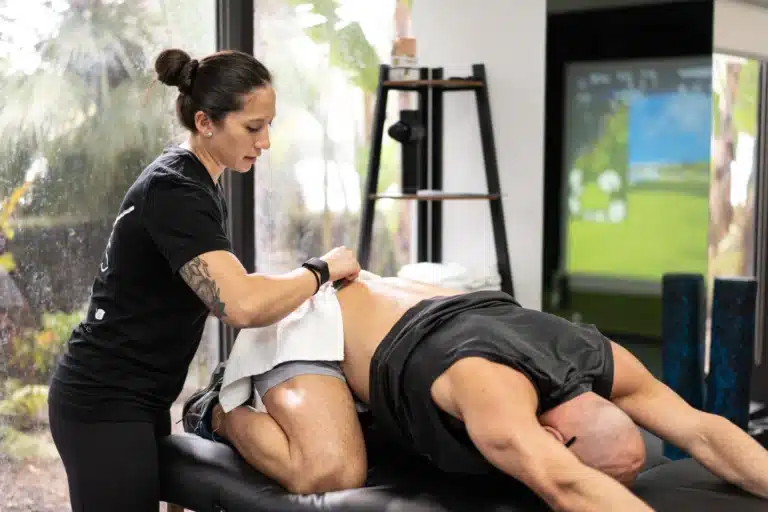
- Manual therapy and joint mobilization to improve joint motion
- Soft tissue mobilization, myofascial release, and trigger point therapy for tight or irritated tissue
- IASTM and Myofascial Decompression to address soft tissue restrictions
- Compression therapy, including Normatec, to support recovery
Active Care
- Therapeutic exercise and resistance training to build strength where you need it
- Mobility work to improve flexibility and usable range of motion
- Balance and proprioception training to sharpen movement control
- Neuromuscular re-education to restore smooth muscle timing
- Plyometrics and return-to-sport progressions to rebuild speed, power, and confidence
Each piece has a purpose. You will not be handed a generic exercise sheet and sent on your way.
What Happens During Your 75-Minute Initial Evaluation
Your first visit is where we separate guesses from answers. We set aside 75 minutes, one-on-one with your Performance Physical Therapist, so nothing feels rushed.
You can expect:
- A detailed conversation. We discuss your history, training habits, past injuries, and what you want to get back to.
- Movement testing. Depending on your needs, this may include a functional movement assessment, a movement screen, TPI testing, running gait analysis, or running form assessment.
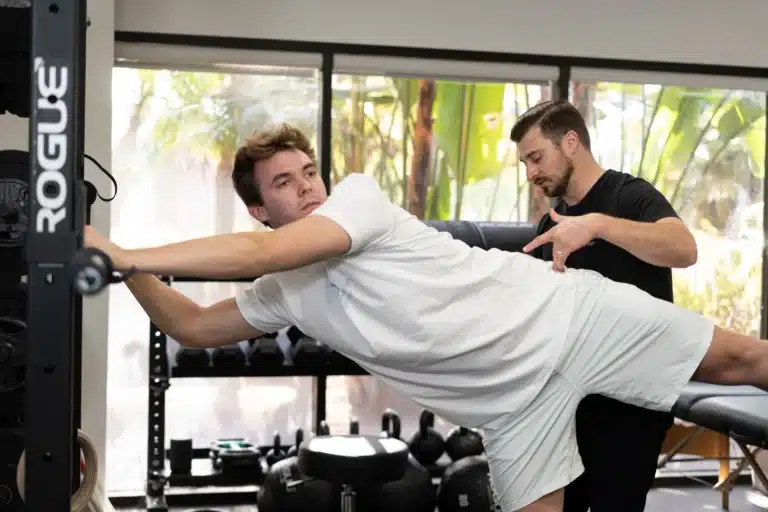
- Hands-on examination. We assess joint motion, tissue quality, strength, and control to find what is driving your symptoms.
- Objective measures when needed. Isokinetic or dynamometer testing can help quantify strength and compare one side to the other.
- A clear plan. You leave knowing what we found, what we will do about it, and how we will move toward your goals.
This depth is what allows us to treat the cause instead of chasing symptoms.
How to Return to Sport Safely and Stay There
Feeling better is not the same as being ready. Returning too soon is one of the most common reasons injuries recur, so we build a progression that confirms you are truly prepared.
A smart return plan typically includes:
- Restoring pain-free motion and baseline strength
- Rebuilding power and control with plyometrics and sport-specific drills
- Return-to-sport testing to verify strength, movement quality, and readiness under demand
- A gradual increase in training volume so your body can adapt
Care at The Movement Schopp extends beyond the injury itself. Many athletes work with us for prehab before a season, post-surgery rehabilitation, mobility and flexibility goals, posture improvement, and strength building. If you are a desk worker who trains hard after hours, we can also address ergonomics and posture. Our approach supports healthy aging as well, so you can keep playing, lifting, and running for years to come.
Want to see everything we offer? Visit our services page or learn more about who we help.
Why Choose The Movement Schopp in Laguna Niguel
You have options when it comes to physical therapy. What you deserve is a team that understands your sport and your drive.
- We speak your language. Our therapists train, compete, and recover like you do.
- We specialize. Golfers, runners, CrossFit and functional fitness athletes, and endurance athletes are the heart of our practice.
- We give you time. Your 75-minute evaluation and one-on-one sessions mean real, focused attention.
- We aim higher than pain relief. Better swing efficiency, smoother running mechanics, and stronger lifting technique are built into the plan.
Our Laguna Niguel clinic serves athletes throughout Orange County. We also have a location in Torrance for South Bay athletes. For more training and recovery insights, browse our blog or return to our home page.
Ready to Get Back to the Game You Love?
You do not have to accept pain as the price of staying active. With the right plan, you can move better, lift stronger, swing smoother, and run farther.
Book your 75-minute initial evaluation at The Movement Schopp in Laguna Niguel today. Let’s find the root cause, build your plan, and get you back to doing what you love at your best.